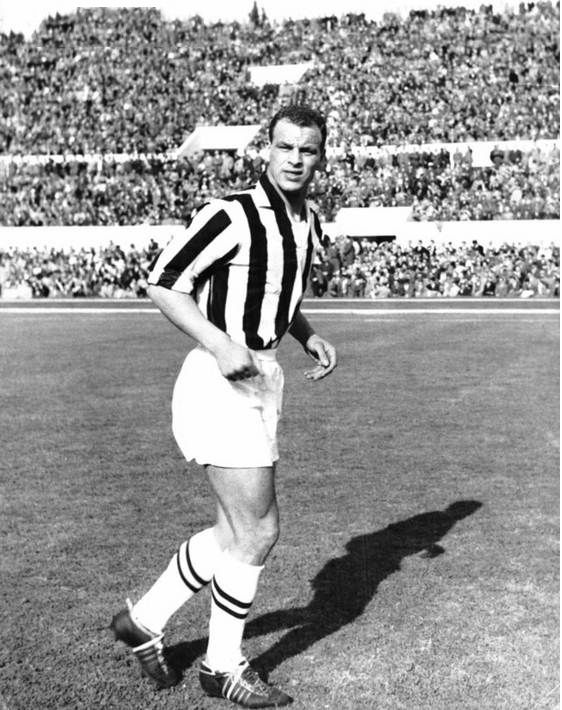
William John Charles was born in Swansea on December 27 1931 and during his 25 year footballing career, the giant Welshman became one of the best players ever to grace the field. His brother Melvyn also became a professional footballer, though Melvyn did write an autobiography called ‘In the Shadow of a Giant’, Melvyn scored 117 goals in 379 league appearances and notched 6 goals in 31 international caps for Wales, so the title of his autobiography tells us all we need about the impact that his elder brother had on the footballing world.
John Charles’ career started at the youth system with Swansea Town who later became Swansea City, and left school at 14 years of age to join the ground-staff at Vetch Field. Unfortunately for him he was never given the opportunity to play for the first-team at Swansea due to his age, he only represented the club once at reserve level. While playing for a local youth club called Gendros in Swansea, he was scouted by Leeds United and given a trial in September 1948. At the subsequent trial, he impressed officials and duly signed for Leeds United at the age of 17 and relocated to Yorkshire. Charles’ best position was not known at the time so then manager of Leeds, Franklin Charles Buckley played him in a variety of positions which included right back, centre-half and left-half for the reserve side. Charles’ made his first-team debut for Leeds in a friendly against Queen of the South on 19th April, 1949. Charles’ was tasked with marking Scotland forward Billy Houliston who ten days previously at Wembley had ran the England defence ragged as the Scots won 3-1. The score at Elland Road was 0-0 and after the game Houliston said 17-year-old Charles was ”the best centre half I’ve ever played against”.
John Charles made his league debut for Leeds against Blackburn Rovers also in April, 1949, playing at centre-half. From 1950-52 he was away on National Service with the 12th Royal Lancers at Carlisle. The army allowed him to turn out for Leeds but also saw to it that he played for them, and in 1952 Charles skippered his side to the Army Cup, during this period he had operations to repair cartilages in both knees. He returned to the Leeds side in November 1951, playing at centre-forward and centre-half, due to his excellent play at both positions, it prompted debate as to where he should play in the team, but he remained at centre-half until the 1952-53 season. In October 1952, manager Franklin Charles Buckley decided to switch him to a centre-forward and Charles was an instant impact up top with 11 goals in 6 games. Throughout the 1952-53 season, Charles scored 27 league goals which was over a third of the total goals scored by Leeds in that season. The 1953-54 season under new manager Raich Carter saw more of the same from Charles in the centre-forward position, scoring an incredible 43 league goals from 42 games, Leeds again finished 10th in the Second Division, the same as the 1952-53 season. That position would’ve been much lower had it not been for Charles as Leeds only scored 89 goals during the 1953-54 season with nearly half of them coming from the extraordinary Welshman.
The 1954-55 season was a transitional one for Leeds United, as Charles himself longed for First Division football and submitted a transfer request, Leeds signed Harold Brook from Sheffield United for a fee of £600, who was 32 at the time and signed more as an insurance policy if Charles did leave for pastures new. There was interest in Charles from Arsenal and Cardiff City, but Leeds United’s aim was to gain promotion to the First Division. Chairman Sam Bolton was unequivocal saying ”Our aim is to get to the First Division and we cannot do that by selling our star player”. In the end swayed by strength of support from above, Charles backed down and withdrew his request for a move. Though Charles’ goalscoring form wasn’t what it was the previous two seasons, the team significantly improved and finished fourth in the Second Division. Raich Carter decided to move Charles back to defence hence the effect on his goal-scoring record, one would wonder if he had played up front, would Leeds have won promotion?. Leeds would’ve been promoted as champions had they beaten Rotherham United at Elland Road but it wasn’t to be and they had to endure another season in the Second Division. One thing was certain for Raich Carter’s side, something had clicked and they would be a promotion push coming for the next season.
In 1955, Charles was appointed club captain and it seemed this new sense of responsibility had inspired him as he was in scintillating form as he continued as the anchor of the Leeds side. For the 1955-56 season, he started in the defence along emerging youngster Jack Charlton, Charles’ job was to nurture and teach Charlton and in the first eight games together, the side only conceded three goals. Charlton himself said that Charles had taught him a lot on how to play as an effective centre-half, Charlton’s confidence in the position impressed Raich Carter so much that he was able to move Charles back to his preferred position of centre-forward. In the 1955-56 season, he scored 29 goals in 42 league games, what was remarkable about that stat is that Charles played until October in the defence and went on to score 28 goals in 28 games. Leeds ended that season with eight wins in their last nine matches and through Charles’ goals and Charlton’s fierceness in defence, the club finally gained that elusive promotion to the First Division after nine years in the wilderness. Charles was instrumental in the club’s growth from a mid-table Second Division to a promotion winning one.
The 1956-57 season saw John Charles’ gain his wish of First Division football, but what was more important to him that he did with Leeds United. Leeds started the season fantastically, in second place by mid September, with Charles demonstrating that he could handle the First Division with ease after nine goals in the opening nine games. The football Leeds were playing was thrilling but in as September 1956 came to a conclusion, something happened which was to have a huge impact on the club and change course of events for the next few years, an event which eventually led to John Charles’ departure from Leeds United. During the early hours of September 18, 1956 a fire caught hold of Elland Road and completely gutted the West Stand, the blaze consumed the entire structure and unfortunately nothing could be saved which included the dressing rooms, press box, club records and directors’ box. After the club forked out £180,000 for a new stand, finances were tight and in a sorry state, and eventually forced the club to part with their prized asset. Leeds had always said they would not part with Charles but after the financial troubles due to the fire, it became inevitable that Charles would had to be sold. Charles’ goal-scoring form did not suffer as he finished the season with 39 goals, clubs throughout Europe had been chasing Charles in the Second Division but after seeing what he could do at the top level, the chasing intensified.
As Charles represented Wales in the final game of the 1957 Home International Championships, he was scrutinised by one of the wealthiest men in Europe, Signor Umberto Agnelli was a member of the wealthy family that owned the Fiat car company and was the main man behind the running of Juventus Football Club, he flew into the UK to cast a final eye over the man they’d been mulling over for two years. News circulated around Europe that The Old Lady were interested in the Welshman, this led to rumours that Real Madrid, Inter Milan and other clubs who could afford what was bound to be a massive fee. On April 10, 1957 things came to a head as Leeds announced that Charles will not be leaving for another English club, and Agnelli finally got his man as Juventus agreed a huge £65,000, a British record at the time. A fee which significantly boosted the Leeds United bank balance, although it left them missing possible the world’s most talented player. Charles played his last match for Leeds United against Sunderland and in typical Charles fashion scored two goals. Charles left Leeds United after 8 years and 157 league goals in 297 appearances.
Charles made his debut for the Italians on 8 September, 1957 against Hellas Verona and scored the winner in a 3-2 victory, goals followed in the following two weeks and in his first three games for Juventus, Charles had scored the winner in each of them. Goals wasn’t a problem for the Welshman at Turin as in his first season he scored 28 goals and was voted player of the season as Juve won the Serie A title. The goals continued for him in his second season however Juventus weren’t able to retain the Scudetto as he scored 19 goals, however they did win the 1958-59 Coppa Italia. More success followed in the 1959-60 season as Juve won a domestic trouble, with Coppa dell’Amicizia following the Serie A and Coppa Italia. Charles was a part of ‘The Holy Trident’ at Turin along with Enrique Omar Sivori and Giampiero Boniperti who were a prolific partnership during the Welshman’s time in Italy. During his five years at Turin, Charles scored 108 league goals in 155 appearances, winning the Serie A three times and the Italian cup twice. He also place third in the 1959 Ballon d’Or and in his time at Turin, he earned the nickname ”il Gigante Buono’ (The Gentle Giant) due to his size and fair play.
In 1962 John Charles returned to Leeds after Don Revie paid a club record £53,000 to bring him back to Yorkshire. The excitement of his return allowed Leeds United to raise admission fees for the 1962-63 season such was the adaulation of the fans for him. His second spell was less successful as he struggled to adjust to life and football back in Britain. After 11 games and three goals for Leeds, a shadow of his former self, Charles was back on his travels to Italy as he was sold to AS Roma for £70,000. Unfortunately he couldn’t replicate the success of his spell at Turin with Juventus as after only a year in the Italian capital, Charles was on the move again. He left AS Roma to join Cardiff City in 1963 and stayed in the Welsh capital until 1966, scoring 18 league goals for the Bluebirds. His spell with Cardiff marked the end of his league career. In 1966, he joined Hereford United and in 1967 became player-manager of the Southern League side. Even though he was 35 years old at the time his quality was still there to see as in the 1966-67 season he scored 37 goals for the Bulls, in his five years at Hereford he scored 80 League goals before he in 1972 he went on to manage Merthyr Tydfil where he stayed until 1974 which marked the end of his playing career.
For his country, Charles made 38 international appearances and scored 15 goals and also represented Wales at the 1958 FIFA World Cup, the only time all four home nations have qualified for the same World Cup. Wales made it through the group stage, but unfortunately for Charles he sustained an injury against Hungary which meant he missed the quarter-final against Brazil, which Wales lost, a result that might have been different had he been available.
Following his retirement, Charles stayed close to the Leeds area running a pub close the club’s stadium. He was made a CBE in 2001 ”for services to Association Football”. He continued to attend Leeds games at Elland Road, and in 2002 he was made a vice-president of the Football Association of Wales, and in 2003 was granted the freedom of the city of Swansea. Also in 2002 he was an inaugural inductee to the English Football Hall of Fame. In January 2004 he suffered a heart attack before passing away on February 21 2004.
Following his death, Leeds United renamed the West Stand of Elland Road, ”The John Charles Stand” in his honour, the South Leeds Stadium used by the club for it’s reserve games was renamed ”The John Charles Stadium and a street close to Elland Road was named ”John Charles Way”. Charles has cemented his legacy in football and in the history of Welsh football, English football and Italian football. In the foreword for his autobiography, Sir Bobby Robson described him as ”incomparable” and classed him among the all-time footballing greats such as Pele, Diego Maradona and George Best, saying ”John wasn’t only one of the greatest footballers who ever lived. He was one of the greates men ever to play the game”. He also noted that Charles was incomparable due to being world class in two very different positions – centre-half and centre-forward. The respect earned in Turin was evident as on occasion of Juventus’ centenary in 1997, he was voted the club’s best-ever foreign player. Welsh referee Clive Thomas said of Charles’ temperament on the pitch and sporting behaviour ”If you had 22 players of John’s calibre, there would be no need for referees – only time-keepers”.
Charles was an excellent footballer and was renowned for being a prolific goalscorer, capable of scoring with both feet, a menace in the air and being a fantastic technical footballer with skills and passing ability. Being a great technical player with the physique he had allowed Charles to excel as a striker and a defender. He was also known to be a fair player known for his correct behaviour, along with his stature earned him his nickname ”The Gentle Giant” while playing for Juventus. On 29 November, 2003 to celebrate UEFA’s jubilee he was selected as the Golden Player of Wales by the FAW as their most outstanding player of the past 50 years. John Charles will always be fondly remembered by Welsh fans for the impact he had on the game in Wales, Leeds United fans will always remember him as a giant of the club and a legend for what he did for the club and by Juventus fans for being ”The Gentle Giant”. What is certain, John Charles was a very special footballer and of the best to have graced any field.
 Story of football in Wales and all over the world